When I saw on Twitter that my friend Julia Moore had tweeted she
Decided adding #sourdough culture to some of our freshly pressed apples would be one experiment too far
I was intrigued and pointed her to my Bouza bread beer experiment. Despite my warnings she embraced the challenge.
Julia kindly agreed to write a guest post about her experiment. Below she describes how she used her Red Fife wholewheat sourdough culture to kick-start a small-batch cider ferment. A follow-up post will show how she used the spent solids (barm) to make cider barm bread.
Julia says:
I hope this little experiment encourages someone else to have an idea and then just have a go 🙂
Exactly the attitude this blog promotes. Read on for her method and results…
Making cider with sourdough
These are my first steps into fermenting alcoholic beverages; until now my focus has been wild-yeast bread baking. I don’t consider myself a baker or a brewer, and I’m often a bit domestically challenged, but I’ve become fascinated by sourdough and wild-fermentation. Over the past 18 months I created several cultures and tried different experiments when time allowed.
This post records my attempt to use a Red Fife wholewheat wild-yeast culture to ferment apple juice into cider. See note below
The apples
We’re fortunate to have six mature apple trees next to our workshop on the edge of Greenham Common, Newbury. After visiting the Newbury Ale & Cider Festival in September we decided to press the fruit and make cider. At the end of November we hired an apple scratter and press and, together with a friend, produced about 50 litres of fresh apple juice.
We filled two 25-litre demijohns and chose different approaches. Our friend sterilised one barrel, added champagne yeast and sugar to boost fermentation. I admit I nearly cried when I heard he’d killed the natural yeasts. For our barrel we planned a 100% natural ferment: nothing added and nothing removed. If it turned into vinegar, so be it.
After about six days the natural fermentation began in the 25-litre barrel. That’s when I wondered whether a portion of my active sourdough culture could be used to inoculate a small quantity of juice and help the cider ferment.
The experiment
Equipment
Two empty 1-litre glass bottles, a domestic juicer, a box of apples and my sourdough culture.
Method
I prepared a small sourdough ferment and mixed it with fresh-pressed apple juice and a little flour to encourage activity. My initial starter mix was:
5 g wholewheat culture + 10 g Red Fife flour + 15 g juice
I then added the activated sourdough to apple juice at roughly 2% by volume. For a 1-litre bottle I added about 20 g of the starter.
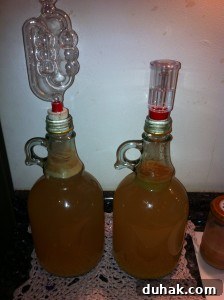
Within 24 hours fermentation was obvious: tiny bubbles throughout the liquid, a frothy head in the bottle neck, flour settling on the bottom and bits of bran pushed up through the airlock. The activity exceeded my expectations—the sourdough rose in the neck of the bottle—so I removed some of the collected culture. To me the sourdough had done its job by kick-starting fermentation and helping natural apple yeasts to become established.
I used a small portion of the removed starter to inoculate a second 1-litre bottle, this time using only 5 g of sourdough. The second bottle also showed clear fermentation within 24 hours. Placed side by side on the kitchen counter, the bottle with the smaller inoculum kept a slightly richer color, while both samples looked paler than the 25-litre barrel undergoing a fully natural ferment.
Even after removing culture from the neck of the first bottle it continued to bubble vigorously, so I cleaned the airlock and removed a little more barm.
For future batches I would add about 5 g of 60% hydration wholewheat culture per litre and leave more headspace so the barm can collect in the neck.
Allow fermentation to continue until bubbles stop passing through the airlock. For my small bottles that took about 30 days; then the cider was ready for racking.
Siphon the clear cider off the sediment carefully and reserve the remaining solids and barm for baking.
Results
At racking the cider tasted quite dry and measured about 6.5% ABV. I bottled three small samples: Bottle one I called Magic Mushroom, bottle two Red Cloud, and Mushroom Cloud is a blend of the two. As an extra test I added 1.25 ml of Sheepdrove honey to the blended bottle.
The bottles are now resting in the garage until spring/summer. I’ll post an update after further conditioning and tasting.
I’ll report back next year with tasting notes—Julia 🙂
And watch out for Julia’s next post about the cider barm sourdough bread – Carl 😉
Note on the sourdough culture
I started this wholewheat culture at the Summer Solstice 2013 using Red Fife grain grown and milled at Sheepdrove Organic Farm, Lambourn. The initial mix included a teaspoon of Sheepdrove borage honey, but since then I’ve maintained it with just Red Fife flour and water. The culture is very lively, so I keep it at approximately 66% hydration (three parts flour to two parts water). Go to where you were