A recipe gives you the steps, but the tin is the foundation. Changing the size, shape or material of your baking tin affects how heat moves through the batter and how the finished bake will look and rise.
Swapping a 20cm round tin for a 20cm square one, for example, increases surface area by roughly 25%. This guide helps you handle those changes so your bakes turn out reliably, whatever pan you use.
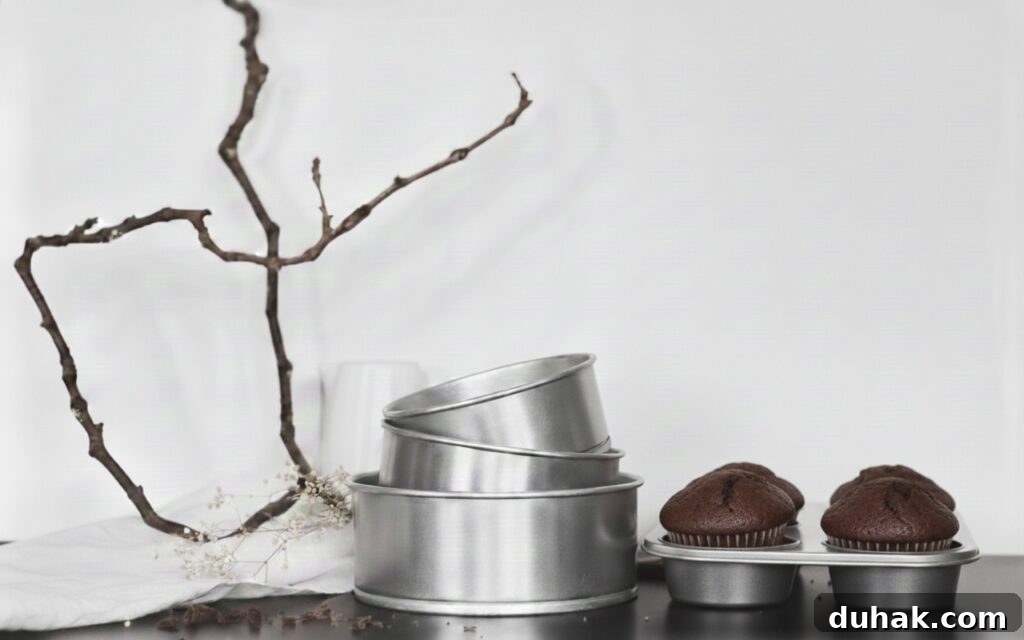
Baking is spatial geometry. When you change the shape, you change the way heat travels to the heart of the cake.
THE CORE PRINCIPLES OF VOLUME
Before you pour, keep these three practical rules in mind when swapping tins:
- The Two-Thirds Rule: Never fill a tin more than two-thirds full. Batter needs space to rise; if it reaches the rim too soon the structure can collapse.
- The Water Test: If you’re unsure whether a recipe will fit a new pan, fill the original tin with water and pour it into the new one. If the water level matches, the batter will too.
- Surface Area vs. Time: A shallower, wider tin bakes faster than a deeper, narrower one. When using a wider, shallower pan, reduce the oven temperature by about 10°C and start checking for doneness 10 minutes earlier than the recipe suggests.
Dane’s Tip: If you’re unsure if your batter will fit, measure with water. If the tin takes 6 cups of water, use no more than 4 cups of batter to leave room for the rise.
SHAPE SHIFTING: COMMON CONVERSIONS
Shortcuts for swapping shapes without complex calculations.
Round to Square
Square tins hold more volume than round tins with the same measurement across. To keep the cake height similar, move down one size when switching from round to square.
- 15cm (6″) Round = 13cm (5″) Square
- 20cm (8″) Round = 18cm (7″) Square
- 23cm (9″) Round = 20cm (8″) Square
- 25cm (10″) Round = 23cm (9″) Square
The Loaf Tin Logic
A standard 22cm × 12cm loaf tin is versatile and often substitutes well for round or square tins.
- It roughly equals an 18cm round tin or a 15cm square tin in volume.
- A typical loaf tin holds about 6 cups (1.5 L) of batter.
- Note: Loaf tins are deeper, so expect to increase bake time by 10–15 minutes compared with a shallower pan.
Muffin & Cupcake Swaps
- A standard 20cm (8″) round cake recipe typically yields 12–15 standard cupcakes.
- Bake cupcakes at the same temperature as the cake but reduce the time to about 18–22 minutes, checking for a springy top or a toothpick that comes out clean.
THE VOLUME REFERENCE MAP
Values assume a standard depth of about 5 cm (2 inches).
| Tin Shape & Size | Approx. Volume (Cups) | Best Replacement |
| 15cm Round | 4 Cups | 1 loaf tin (22cm × 12cm) |
| 20cm Round | 8 Cups | 18cm Square tin |
| 23cm Round | 11 Cups | 20cm Square tin |
| 20cm Square | 10 Cups | 23cm Round tin |
| 23cm Square | 14 Cups | 33cm × 23cm Rectangular pan |
A NOTE ON MATERIAL
Dark vs. Light Tins The finish and material of your tin affect baking as much as its size.
- Dark or Non-stick Tins: These absorb more heat and can brown the edges faster. If the edges brown before the center is set, lower the oven by another 10°C.
- Aluminium (Professional): Lightweight aluminium distributes heat evenly and is often the most reliable choice for consistent results.
Lining your baking tins
A correctly lined tin helps your cake rise evenly and release cleanly. Paper that doesn’t sit flush can cause pleated edges or uneven climbing.
The Round Tin: The “Fringe” Method
To fit paper to curved sides without bunching:
- The Base: Trace the tin bottom on baking paper and cut just inside the line.
- The Collar: Cut a long strip of baking paper slightly taller than the tin’s sides.
- The Fringe: Fold the bottom 1 cm of that strip upward and snip small V-shaped notches every 2 cm to allow the paper to curve.
- The Install: Grease the tin, press the fringed strip into the corner so it sits flat, then place the base circle on top to secure it.
The Square Tin: The “Cross” Method
For clean corners and easy lifting, use two strips laid in a cross:
- Cut two strips of baking paper the full width of the tin’s base.
- Grease the tin and lay the first strip across the base with handles hanging over two opposite sides.
- Lay the second strip perpendicular to the first.
- This creates a double-layered base, neat corners and built-in handles to lift the cake out safely once cool.
Dane’s Tip: Always grease the tin before placing the paper, and consider greasing the paper lightly too. This helps the paper stay in place while you spread the batter and ensures the cake releases cleanly once baked.
Looking for more tips and techniques? Explore basic baking guides and practice the methods here to build dependable habits that make your baking consistent and stress-free.